

I don't know how many times I get asked the question, what should I purchase a jointer or a planer. The quick answer to this is both, but for those who want to know why, or what alternatives there might be, read on.
Depending on where you obtain your wood, it can be anything from rough to finely milled and ready to use. In many cases wood is purchased "rough cut" and needs to be finely milled. The reason for this is that whoever milled the wood, has no idea what you are going to make with it, so they cut the wood on the large size you you can re-size it to fit your project and as well as to cut around, or include any "features" of the wood like figure, knots etc.
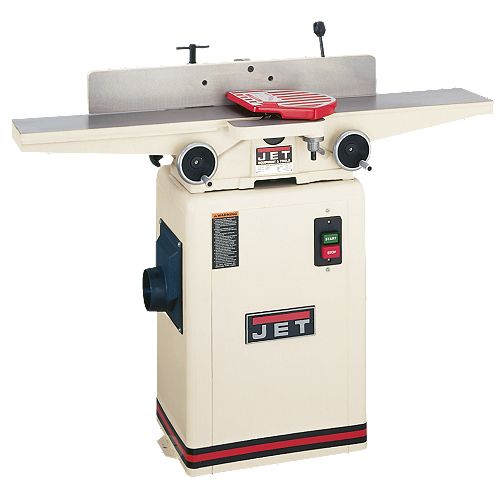
Making the board the proper thickness is very different than making them flat, with straight working edges. The job of making a board flat, straight and square MUST start with a jointer. No other tool can do this task. The job of a jointer is to make two edges of a board flat and square to one another. To begin with, you need to evaluate each board, and what it is going to be used for. If a board is a bit rough on one or both of the faces, one of the faces needs to made flat and straight. Once the board is flat and traight, the second edge needs to be finished the same way, and it normally needs to be at exactly 90 degrees from the first face you just finished. If a jointer is correctly aligned, that is with the fence absolutely perpendicular to the bed and knives, you should be able to joint one of the edges of the board.
If you are using one of the popular, quality jointers like Delta , Jet, Ridgid, Steel City, etc. with at least a 6 inch blade, you will be able to flatten and true one face then mill one edge using the fence as the guide. When you have done this, you will end up with one face and one edge that are true, straight and at 90 degrees to one another.
The idea of a jointer is to make two edges of your boards exactly flat and 90 degrees to one another. Once this is done, other tools in your shop will work to "finish" your board by making all sides flat and both opposite edges parallel.
Once your board is flat and "squared", it is now time to make it parallel and true on the opposite sides which are still rough.
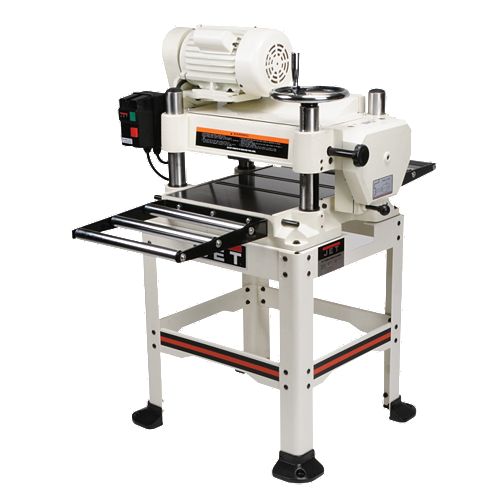
The tool to make a board equally flat and true on the face sides is the planer. The planer can not make one face of a board flat and straight, that was done by the jointer. The role of the planer is to adjust the thickness of the board.
The planer does this by literally squeezing the board between a series of steel rollers and the cutting blades. If there is a large lump or dip on the side of the board that runs through the roller side of the planer, this same defect will be reflected by the cutter blades on the other side of the board. This is why it is so important that a board be flat and straight BEFORE it is planed, otherwise there is a high probablility you wll be simply duplicating the boards defects, just making them thinner.
After you have run the board through the Jointer you will now have a board that is flat and true on two face sides. Now is the time that the thickness of the board can be adjusted and this is done with the Planer. If the board is wide enough to run through you planer to true up the oposing sides, then go ahead and do that. If the board is too large, you may want to run the board through your table saw to make sure all edges are true and parallel.
So the answer of which too you should get first a a Jointer or a Planer is answered by which tool you would use in the workshop first, and that tool is almost always the Jointer.
If the wood you are working with in finely milled, (i.e. dimensioned by thickness) you might be able to get away with just a jointer. In any case, a jointer will prove invaluable if you are going to be building quality wood products.
In simple terms we normally recommend a Jointer first.